Mayan cross-chain swaps, transfers, and destination actions
Mayan connects cross-chain token swaps with destination-chain actions, including deposits and staking, through its Zaps feature. The wider service combines a public swap app, developer tools, and the protocol underneath both. It handles routing and execution across networks including Solana, Ethereum, Base, and Sui. Available transfer methods include Swift, MCTP, and Wormhole Swap, each using a different mechanism. Drivers compete to execute orders, while integrations can add gas sponsorship and custom fees. The intended outcome can be a token transfer, a payment, or funding an onchain account, so the destination purpose matters alongside the asset movement.
A transfer method determines how tokens move across chains, while Zaps connect that movement to a destination application's action.
Token swaps and transfers across supported networks
A cross-chain swap combines token exchange with movement between networks, while bridging focuses on the cross-chain transfer. These purposes overlap within the service. The intended endpoint includes both the asset and the network where it should arrive. A token balance on another chain can also supply assets for a connected application action.
Network coverage also includes Arbitrum, BNB Smart Chain, Monad, and HyperEVM.
How do Swift, MCTP, and Wormhole Swap differ?
Swift uses destination-chain driver capital, MCTP uses Circle's CCTP, and Wormhole Swap uses the Wormhole Token Bridge.
Swift and destination-chain liquidity
Swift uses intent-based fills, with drivers paying from capital they already hold on the destination chain. This method is positioned for most swaps. Prefunded destination liquidity lets a driver pay the user without first waiting for source-chain finality.
MCTP and Fast MCTP
MCTP and Fast MCTP use Circle's CCTP for cross-chain movement, with a focus on high-value and stablecoin transfers.
Wormhole Swap and the token bridge
Wormhole Swap uses the Wormhole Token Bridge for cross-chain transfers. Its documented use case is low-slippage movement of high-value SOL and ETH.
What does the auction change about a swap?
A driver auction brings price competition into swap execution by letting drivers compete to fill an order. The route describes how assets move between chains; competition concerns the execution offers available for an order. Mayan 2.0 included faster auctions and lower participation costs, changes intended to attract more competition and improve pricing across order sizes.
The app, developer tools, and underlying protocol
A ready-made swap interface
The public app provides direct access to swaps without requiring an SDK or widget integration. The Mayan Protocol supplies the smart contracts and execution logic underneath it.
Cross-chain movement inside another product
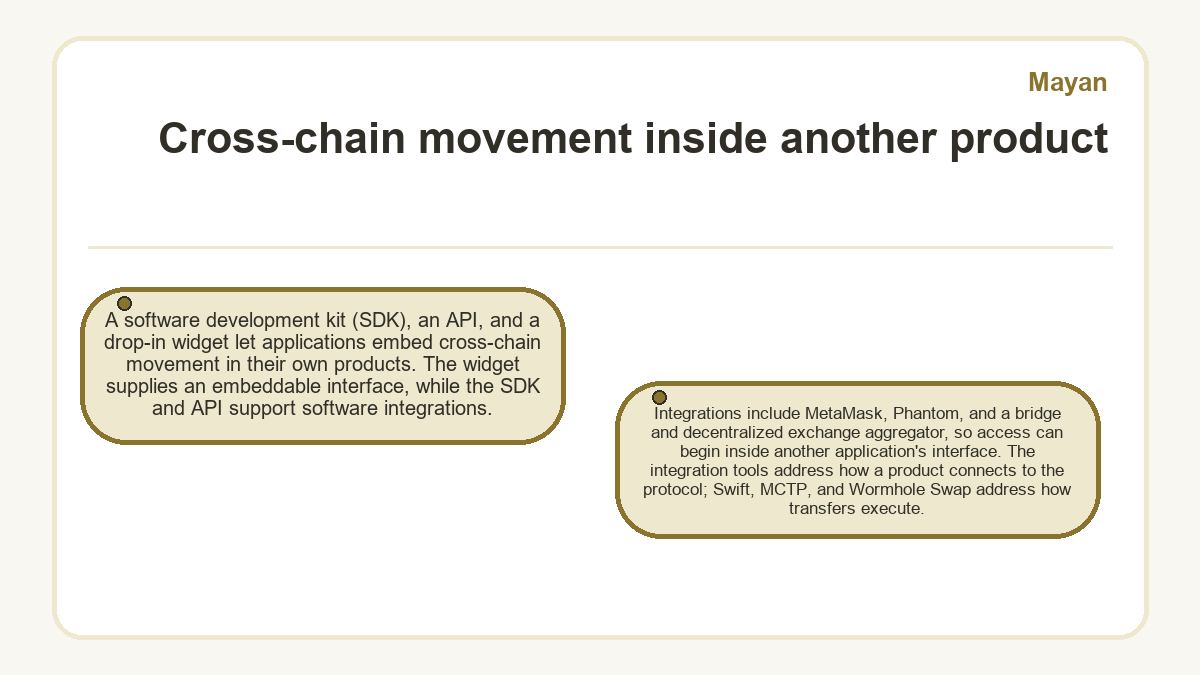
A software development kit (SDK), an API, and a drop-in widget let applications embed cross-chain movement in their own products. The widget supplies an embeddable interface, while the SDK and API support software integrations. Integrations include MetaMask, Phantom, and a bridge and decentralized exchange aggregator, so access can begin inside another application's interface. The integration tools address how a product connects to the protocol; Swift, MCTP, and Wormhole Swap address how transfers execute.
Zaps connect a swap to its destination use
Zaps can combine a cross-chain swap with an onchain action on the destination chain. Supported action types include deposits, staking, payments, and contract calls. A standalone swap ends with the token movement, while a combined flow also includes the destination action the application requests.
The broader product also supports stablecoin payments, alongside funding and withdrawing assets from onchain accounts. A requested deposit or stake requires an integration that supports that destination action.
Who pays gas, and what can an integration change?
For a gas-sponsored transaction, a sponsor covers the applicable gas cost; integrations can also add gas abstraction and custom fees.
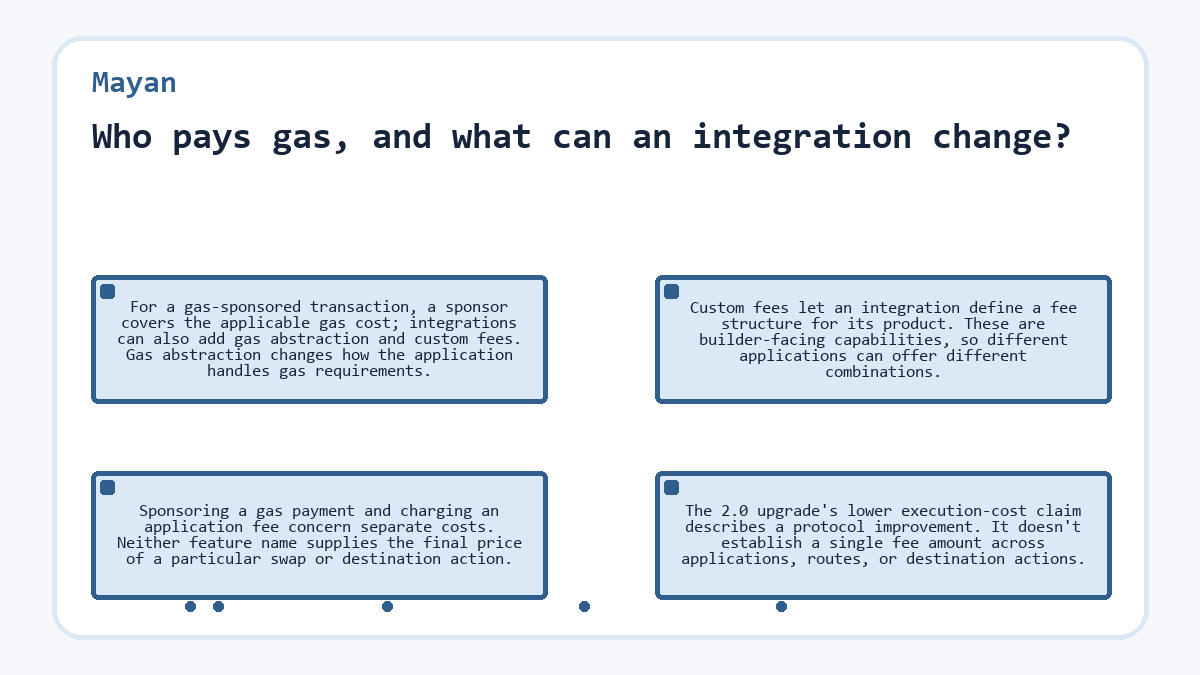
Gas abstraction changes how the application handles gas requirements. Custom fees let an integration define a fee structure for its product. These are builder-facing capabilities, so different applications can offer different combinations. Sponsoring a gas payment and charging an application fee concern separate costs. Neither feature name supplies the final price of a particular swap or destination action.
The 2.0 upgrade's lower execution-cost claim describes a protocol improvement. It doesn't establish a single fee amount across applications, routes, or destination actions.
Matching the transfer to the intended outcome
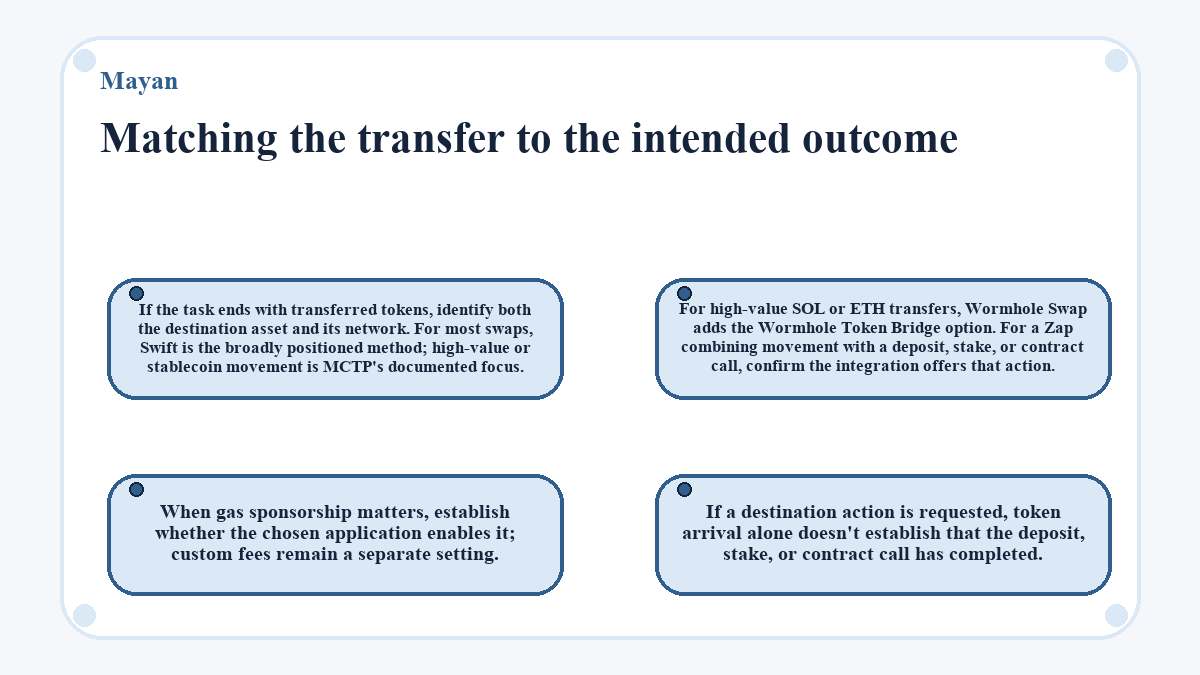
- If the task ends with transferred tokens, identify both the destination asset and its network.
- For most swaps, Swift is the broadly positioned method; high-value or stablecoin movement is MCTP's documented focus.
- For high-value SOL or ETH transfers, Wormhole Swap adds the Wormhole Token Bridge option.
- For a Zap combining movement with a deposit, stake, or contract call, confirm the integration offers that action.
- When gas sponsorship matters, establish whether the chosen application enables it; custom fees remain a separate setting.
- If a destination action is requested, token arrival alone doesn't establish that the deposit, stake, or contract call has completed.
Practical questions
Are Mayan swaps guaranteed to finish in two seconds?
Swift is described as settling in as little as two seconds, which is a fastest-case claim. The figure doesn't apply universally to MCTP, Fast MCTP, or Wormhole Swap. It also doesn't promise that every Swift order finishes in that time.
How much can I transfer with Swift or MCTP?
Swift is positioned for most swaps up to around $1 million, while MCTP and Fast MCTP target transfers up to around $10 million. These approximate figures describe the methods' intended use ranges. They aren't one protocol-wide limit covering every asset and route.
Does the protocol use custodial accounts?
The protocol is non-custodial and uses permissionless smart contracts. That property applies to its underlying asset-handling design. It doesn't establish the account or custody arrangements of every separate application integrating the protocol.
Who has audited the protocol's smart contracts?
OtterSec and Sec3 have audited Mayan smart contracts. The relevant audit scope is the reviewed contract code. That review shouldn't be extended automatically to a separate application, destination contract, or later revision.
When was Mayan 2.0 announced as live?
Mayan 2.0 was announced as live on March 24, 2026. The release paired faster auctions and lower execution costs with Zaps for combining swaps and destination-chain actions, including payments, deposits, and staking.